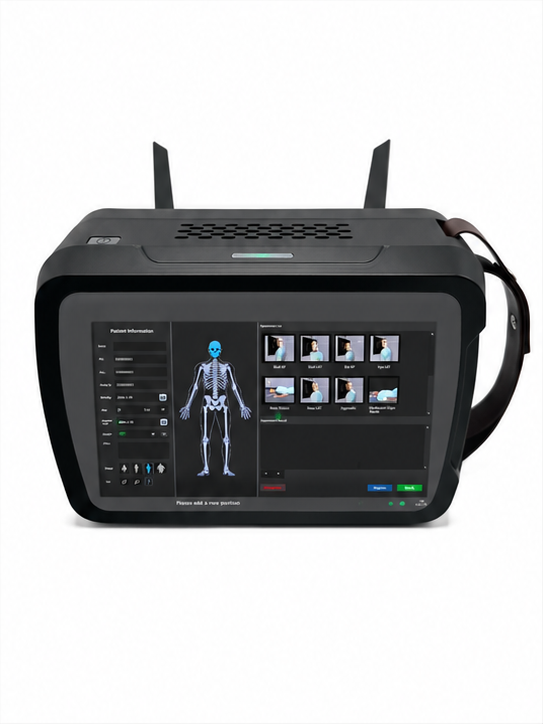
The traditional fixed digital radiography (DR) relies on dedicated radiology rooms, which often limit critical patients, outdoor emergency care, primary care visits, and small clinics due to space constraints, making it difficult to quickly perform X-ray examinations. Today, handheld DR (handheld digital radiography system) has emerged, driving a shift in imaging models from 'patients going to the room' to 'equipment going to the patient'.
The host features a lightweight design, making the entire unit easy to carry. Paired with a protective storage case, it can be easily loaded into a private car. Equipped with a high-capacity built-in lithium battery, it can continue operating without being connected to mains power. Patients in ICU beds, post-operative bedridden patients, and elderly individuals with mobility issues do not need to be moved; imaging can be done directly at the bedside. It is also convenient for rural mobile clinics, field rescue operations, and home visits, reducing the risks associated with patient transportation.
High-definition digital images are output within seconds after exposure, allowing for immediate viewing. Supporting standard DICOM format, images can be wirelessly transmitted, stored, and printed. Doctors can review and diagnose images on-site, saving time waiting for film development and back-and-forth transportation, thus seizing the golden window for emergency treatment.
Equipped with intelligent dose regulation technology, it precisely controls X-ray output. Under the premise of ensuring image clarity, it effectively reduces radiation dose. Combined with mobile protective equipment, it minimizes long-term radiation accumulation for medical personnel, providing greater peace of mind for examinations of the elderly, children, and frail patients.
The intuitive touch-operated interface allows for direct adjustment of parameters, simplifying the imaging process. No need for senior radiologic technologists; basic training enables proficient use, making it suitable for diverse teams such as small clinics, grassroots health centers, emergency teams, and animal healthcare institutions.
Traditional large-scale DR systems are bulky and fixed in installation. They require the construction of dedicated radiology rooms with high renovation costs. Patients must travel to the radiology department themselves, making them unsuitable for outdoor or bedside emergency use.
Handheld DR systems are lightweight and portable, capable of being transported via vehicle or carried by a single person. They eliminate the need for room modifications, reducing initial investment. The equipment can be moved directly to the patient's side, making it universally applicable for in-hospital bedside use, outdoor visits, and field rescue operations.
Medical imaging is moving towards lightweight, mobile, and instant solutions. Handheld DR addresses the imaging gap in mobile healthcare with lower investment and higher flexibility, solving the long-standing challenge of 'difficulty in obtaining images' across numerous scenarios.
Whether it's expanding capacity at primary medical institutions, adding imaging services to clinics, or extending on-site services for emergency teams and animal healthcare providers, handheld DR offers an extremely cost-effective imaging solution.