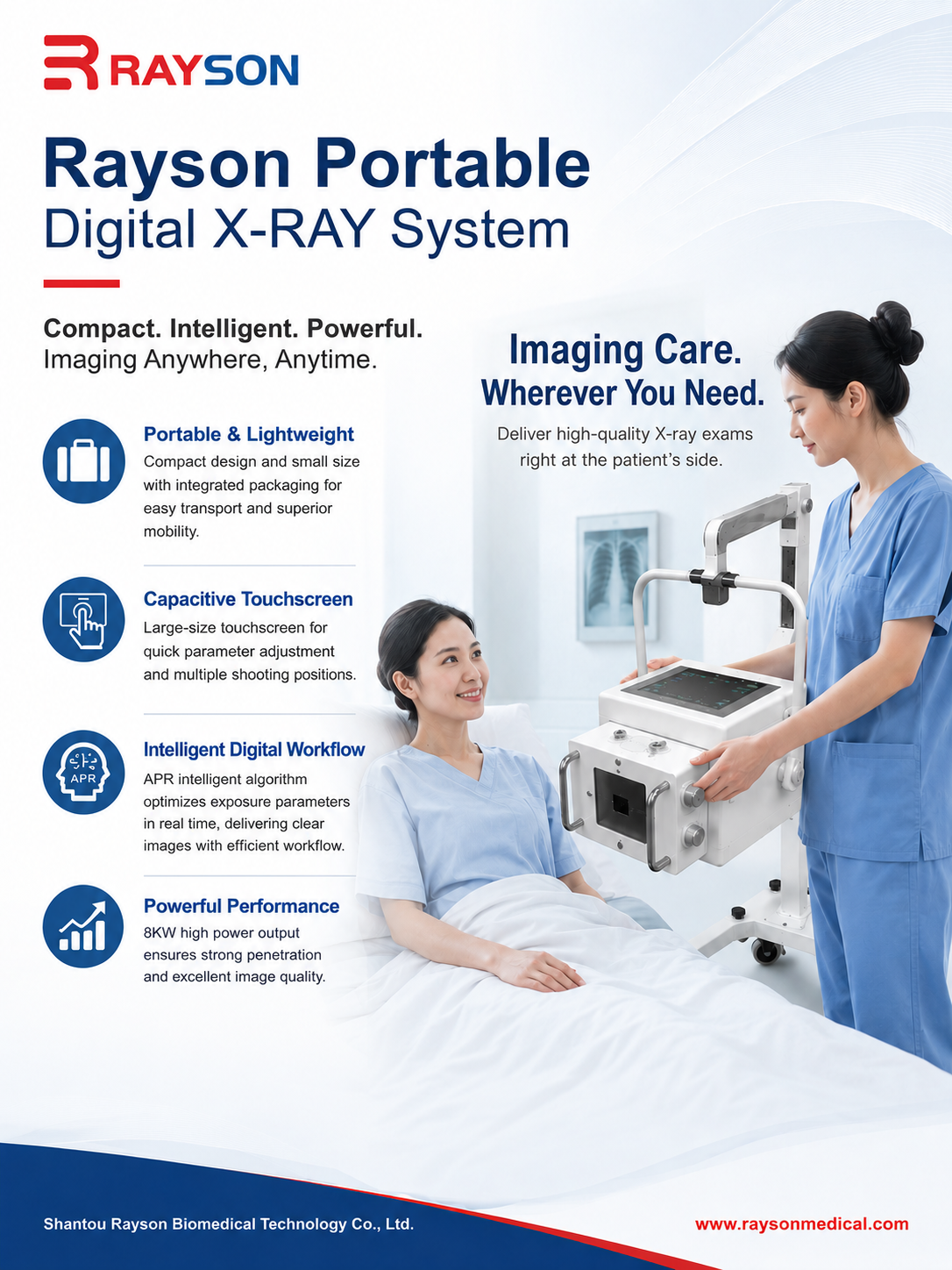
In the field of modern medical imaging, Digital Radiography (DR) systems have become important tools for clinical diagnosis. The emergence of portable DR has further broken through the spatial limitations of traditional fixed DR equipment, extending precise imaging examinations to where patients are located.
Portable DR is a lightweight, mobile digital X-ray imaging device. It consists of an X-ray generating unit, a wireless flat panel detector, and an image acquisition and processing system, enabling high-quality X-ray examinations to be completed quickly in various scenarios.
Compared to traditional fixed DR, portable DR typically weighs only tens of kilograms as a complete unit. Some models can even be disassembled into multiple lightweight modules, allowing a single person to carry and assemble them.
Digital High-Definition Flat Panel Technology
Amorphous silicon/amorphous selenium flat panel detectors offer fast imaging speed, high grayscale levels, and strong spatial resolution. Compared to older CR and film cassette systems, there is no need for a developing process, resulting in images without blurring or ghosting, with enhanced identification of subtle lesions in soft tissues and bones.
Overall Lightweight Mobile Imaging
By using high-frequency compact X-ray tubes and carbon fiber flat panel detectors, the overall weight of the device is significantly reduced. It can be carried and lifted by a single person, allowing flexible deployment in multiple scenarios without the need for a fixed room.
Intelligent Image Processing
Exposure and real-time imaging within 1–3 seconds. It features built-in noise reduction, contrast enhancement, bone window adjustment, and tissue balance algorithms. Images can be instantly magnified, measured, and annotated. There is no need to wait for film development, doubling the efficiency of rapid emergency diagnosis.
Low Radiation Dose Control
Under equivalent image clarity, the radiation dose received by patients is much lower than that of traditional power frequency X-ray machines. Some models come with lead shielding kits, significantly reducing the risk of scattered radiation exposure for medical staff.
The core significance of medical imaging equipment has never been to make patients accommodate the equipment by going to the machine room, but to have the equipment actively approach the patients. This portable DR, with four key highlights—lightweight design, high-definition imaging, low radiation, and full-scenario adaptability—breaks through the spatial constraints of traditional radiological equipment. It not only solves the risk dilemma of transferring critically ill patients within hospitals but also addresses the shortage of imaging equipment in grassroots medical institutions. Additionally, it comprehensively supports public health emergency medical security. The compact body contains great power, combining flexible mobility and high-definition imaging to achieve safety and efficiency, making it an essential mobile imaging necessity for modern hospitals, grassroots medical facilities, and emergency medical services.
As a significant innovation in the field of medical imaging, portable DR integrates the image quality of large-scale equipment with the mobility of mobile devices. It is not only a product of technological advancement but also a powerful tool for extending medical resources to grassroots levels and implementing the concept of bedside precision diagnosis and treatment. For healthcare institutions, proper deployment of portable DR systems will effectively enhance the accessibility and timeliness of imaging examinations, ultimately benefiting a wide range of patients.