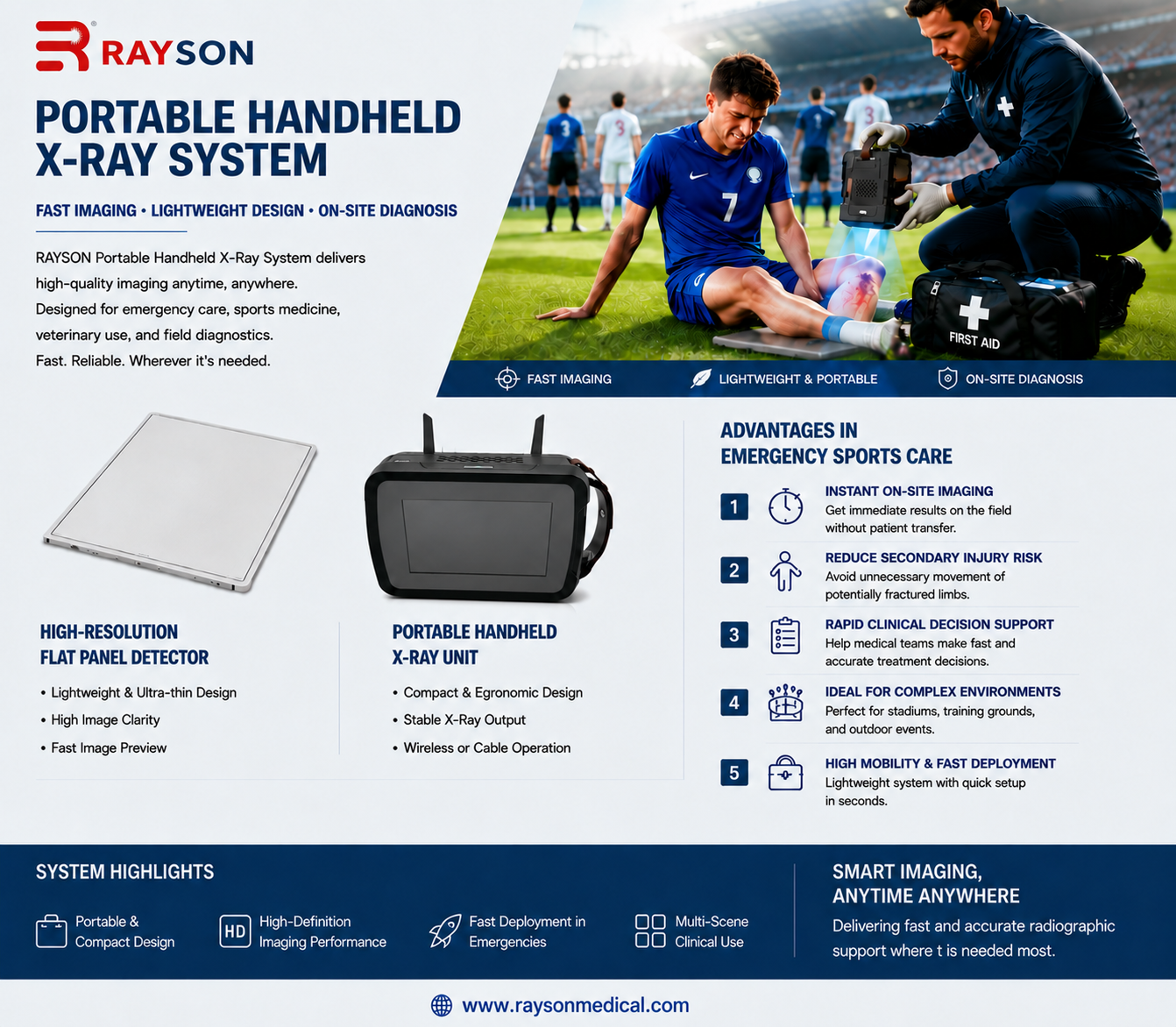
Under the high-temperature schedule of the World Cup involving the U.S., Canada, and Mexico, the risk of fractures and joint injuries from players' high-speed collisions has sharply increased. The ability to quickly complete imaging diagnosis on the sidelines directly determines the efficiency of injury treatment and players' professional longevity. From mobile CT units at the Qatar World Cup sidelines to mobile imaging support vehicles as standard equipment in China's Super League and local football leagues, top-tier competitions have taken the lead in bringing imaging diagnosis forward to the frontlines. Rayson Biomedical's portable X-ray machines are now extending this efficient support model to a broader range of sports scenarios.
In high-contact sports like football, basketball, and ice hockey, fractures, dislocated joints, and chest contusions are common injuries. Under traditional models, injured athletes had to be transported to off-site hospitals for imaging, easily missing the golden window for realignment and disrupting the competition rhythm. Domestic Scottish Premier League stadiums and Chinese Super League home grounds have successively introduced mobile imaging equipment onto the field, allowing for image screening within minutes of an injury, providing precise guidance for on-site treatment. For competition medical support, the closer the imaging capability is to the field, the greater the initiative in injury management.
Professional teams travel year-round across northern and southern regions for training camps. Northern winter bases with -30°C temperatures, high-altitude hypoxic camps, and southern hot outdoor training fields present extreme environmental variations. Traditional imaging equipment often malfunctions due to temperature and humidity changes and cannot accompany teams deep into remote training sites. Athletes could only return to the base for imaging follow-up checks, delaying injury monitoring. In the Guangdong delegation's sports rehabilitation support vehicle for the 15th National Games, a portable digital X-ray machine was listed as a core diagnostic device, traveling with the team across multiple outdoor venues to enable immediate injury assessment and consultation.
Amidst the national fitness craze, mass participation events such as mountain cross-country races, city marathons, and community basketball games have surged. However, these events often take place far from urban hospitals, making timely diagnosis of sports injuries difficult. Minor injuries can easily develop into chronic issues. Many domestic marathon events have equipped medical support vehicles with DR (Digital Radiography) systems, pre-positioning imaging screening capabilities along the race route to quickly assess fracture risks from falls and sprains, preventing secondary injuries from incorrect transfers. For grassroots events, lightweight and easy-to-deploy mobile imaging equipment is the key to filling safety gaps.
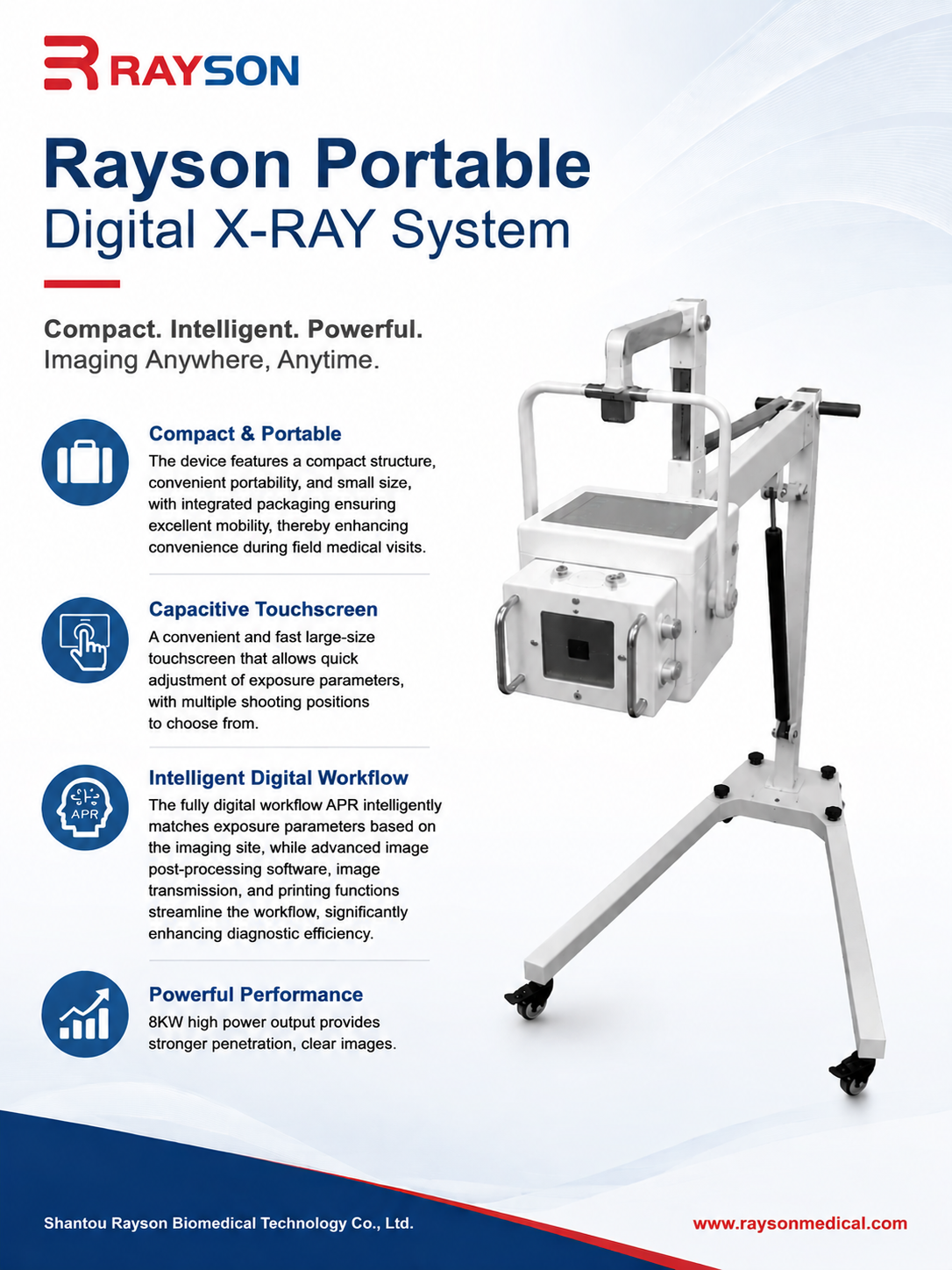
The core capabilities of Rayson's series of portable X-ray machines cover full-level support needs from top-tier competitions to mass sports. They require no dedicated rooms or wiring and can be rapidly deployed in sideline medical tents, remote training fields, and mountain supply stations. Stable operation between -30°C and 50°C adapts to all seasons and extreme environments nationwide; built-in long-lasting batteries support hundreds of independent exposures, with 3-second rapid imaging and wireless picture transmission. Rayson Biomedical breaks spatial and environmental barriers with portable imaging technology, ensuring professional screening keeps pace with the speed of sports, solidifying a health baseline for every all-out effort.